What Risk Management Is
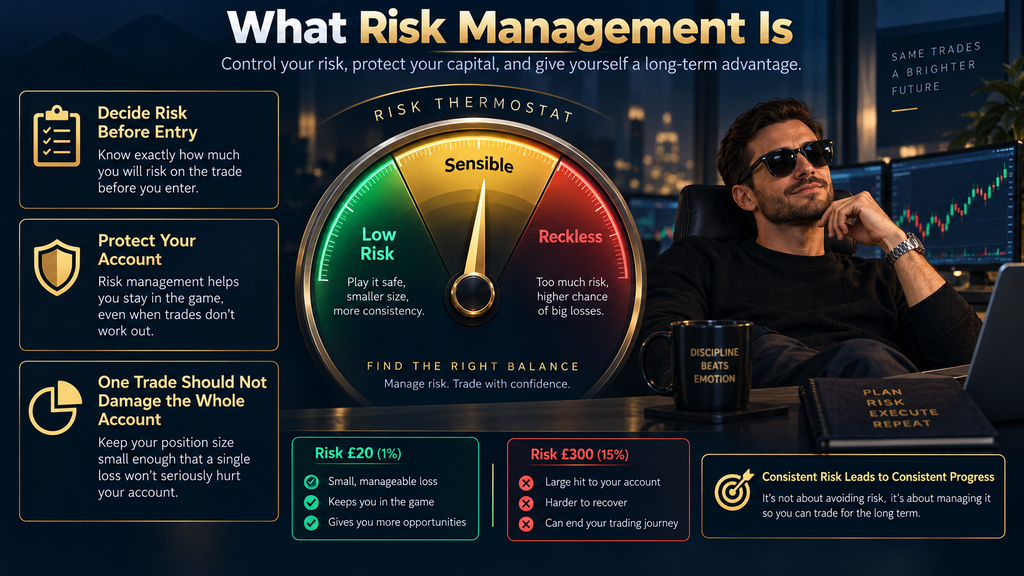
Risk management is the process of deciding how much of your trading account you are prepared to lose before you enter a trade.
It is one of the most important parts of trading because no trader can know with certainty whether the next trade will win or lose.
The goal is not to avoid every loss.
The goal is to make sure that one losing trade, or even a series of losing trades, does not cause serious damage to your account.
Why Risk Management Matters
Imagine two traders who both have a £1,000 account.
One risks £20 per trade.
The other risks £300 per trade.
If both traders lose three trades in a row:
- Trader 1 loses £60
- Trader 2 loses £900
They experienced the same number of losing trades, but the effect on their accounts is completely different.
This is why controlling risk is more important than simply trying to find winning trades.
You Control the Risk Before the Trade
Before entering a trade, you can normally decide:
- how much money you are willing to risk
- where your Stop Loss will be
- how large your position should be
- whether the potential reward is worth the risk
Once these are known, the trade becomes much more measurable.
Risk Management Does Not Guarantee Profit
Good risk management cannot turn a poor trade into a winning trade.
What it can do is help prevent individual losses from becoming unnecessarily large.
A trader can be wrong several times and still have capital available for future opportunities.
Key Takeaway
You cannot control whether the market wins or loses the next trade, but you can control how much money you put at risk.
Risk Per Trade
- Decide your maximum loss before entering
- Keep risk small enough to survive losing streaks
- Do not increase risk simply because a setup feels strong
- Consider the type of account you are trading
Risk per trade is the amount of money you are prepared to lose if your Stop Loss is reached.
For example, on a £1,000 personal live account, risking £10 means risking 1%.
On a prop firm account, the same percentage may need more consideration because daily-loss and maximum-loss rules can reduce the amount of room you actually have.
A risk level that looks reasonable on one trade may become uncomfortable after several losses.
Key Takeaway
Choose your risk before entering and make sure it suits both your account size and any rules attached to the account.
Percentage Risk vs Fixed Money Risk
- Percentage risk changes with your account balance
- Fixed money risk stays at a chosen cash amount
- Either method can create consistency
- Account limits should always be considered
With percentage risk:
£2,000 × 1% = £20 risk
If the account grows, the amount at risk increases. If the account falls, the amount decreases.
With fixed money risk, you might instead decide:
Maximum risk per trade = £20
For a personal live account, either method can form part of a structured trading plan.
With a prop firm account, percentage risk should also be viewed against the firm’s permitted drawdown. The headline account size may be much larger than the amount the trader can actually afford to lose before a rule is approached.
Key Takeaway
Your risk should reflect the loss the account can comfortably tolerate, not simply the size printed at the top of the account.
Position Size
- Position size determines how much each price movement is worth
- Larger positions create larger gains and losses
- Stop Loss distance should influence position size
- Calculate position size from your planned risk
Two traders can take exactly the same setup but experience very different financial results because they use different position sizes.
If your Stop Loss is further away, your position may need to be smaller to keep the same amount of money at risk.
If the Stop Loss is closer, the position may be larger while maintaining the same planned risk.
This applies to both personal and prop firm accounts.
On a prop account, position size also needs to leave enough room for other trades and any daily or overall loss restrictions.
Relevant Trader Tool
Use our Position Size / Lot Size Calculator to calculate trade size from your balance, risk and Stop Loss.
Key Takeaway
Decide how much you are prepared to lose first, then calculate the position size.
Stop Loss Placement
- Place the Stop Loss where the trade idea becomes invalid
- Avoid random placement
- Allow for normal market movement
- Do not widen it simply because the trade is losing
A Stop Loss should normally have a reason for being where it is.
For example, it may sit beyond a meaningful price level or market structure that would suggest the original trade idea is no longer valid.
Your position size can then be adjusted so that reaching this level still produces an acceptable financial loss.
Moving a Stop Loss further away after entering increases the amount at risk.
On a prop firm account, doing this can also move the account closer to a daily or maximum-loss limit.
Key Takeaway
Place the Stop Loss where the trade idea fails, then adjust position size so the financial risk remains controlled.
Risk / Reward
- Risk is what you could lose
- Reward is what you could potentially gain
- Compare both before entering
- A larger reward target does not automatically mean a better trade
If you risk:
£20
to potentially make:
£40
the trade has a potential 2:1 reward-to-risk ratio.
This does not mean the trade is twice as likely to win.
It simply compares the planned reward with the amount being risked.
This is useful whether you are trading your own capital or a prop account because it allows trades to be assessed before money is exposed.
Relevant Trader Tool
Use our Risk / Reward Calculator to compare your Entry, Stop Loss and Take Profit.
Key Takeaway
Know what you are risking and what you are attempting to gain before entering.
Drawdown
- Drawdown measures how far an account has fallen from a previous high
- Larger drawdowns are harder to recover from
- Small controlled losses help keep drawdown manageable
- Prop accounts may have firm drawdown limits
If an account reaches:
£10,000
and later falls to:
£9,000
it has experienced a 10% drawdown from that previous high.
The larger the drawdown, the greater the return required to recover.
For example, after losing 50% of an account, the remaining balance would need to gain 100% to return to its starting value.
On a personal live account, controlling drawdown protects your own capital.
On a prop firm account, drawdown can also determine whether the account remains within the firm’s rules. Different firms may calculate these limits differently.
Key Takeaway
Keeping drawdown manageable protects your ability to continue trading.
Losing Streaks
- Every strategy can experience consecutive losses
- Several losses do not automatically mean the strategy has stopped working
- Smaller risk makes losing streaks easier to survive
- Consider the combined effect of several trades
Even a profitable strategy can lose several trades in a row.
On a personal live account, controlled risk helps prevent a normal losing streak from causing major damage.
On a prop firm account, the same losing streak may also begin to encroach on daily-loss or maximum-loss limits.
For example, several individually reasonable losses taken during one session can add up quickly.
This means a prop trader should consider not only:
“How much am I risking on this trade?”
but also:
“How much risk have I already used today?”
Key Takeaway
Plan your risk for the losing streak that may eventually happen, not only for the next trade.
Over-Risking
- Large risk makes individual trades too important
- Large losses are harder to recover from
- Emotion often increases after a significant loss
- Avoid increasing risk simply to recover quickly
Over-risking means exposing too much of the account to one trade or a small group of trades.
It can lead to a cycle such as:
large loss → frustration → larger trade → another large loss
This is often associated with revenge trading.
On a personal account, this can rapidly damage your own capital.
On a prop firm account, it can also cause daily or maximum-loss rules to be reached much faster than expected.
Key Takeaway
One trade should never have the power to seriously damage the account.
Consistency and Capital Protection
- Follow repeatable risk rules
- Avoid dramatic changes in position size
- Protect capital during difficult periods
- Leave room for future trades
- Consider any account restrictions before the session begins
Risk management is designed to make trading repeatable.
On a personal live account, consistent risk helps protect your own money and makes performance easier to measure.
On a prop firm account, it can also help keep trading comfortably inside the firm’s rules rather than constantly operating close to the maximum permitted loss.
For example, repeatedly taking large risk because a prop account still has some drawdown available leaves very little room for an unexpected losing streak.
Consistency does not mean every trade must use exactly the same position size.
It means changes in risk should come from a deliberate plan rather than fear, excitement or frustration.
Key Takeaway
Consistent risk gives an account more room to withstand normal trading losses.
Prop Firm Risk Rules
- Daily-loss limits may apply
- Maximum-loss limits may apply
- Open losses may count towards limits
- Calculation methods vary between firms
- Rules should be checked before trading
Prop firm accounts can include restrictions that are not normally present on a personal live account.
These may relate to:
- daily loss
- maximum overall loss
- account equity
- open trade losses
- position exposure
- other account-specific conditions
The exact rules depend on the firm and the particular evaluation or funded account.
A trader should understand them before placing trades.
The maximum permitted loss should be treated as a boundary, not as an amount that should routinely be risked.
Key Takeaway
Your personal risk rules should sit comfortably inside the prop firm’s rules, with room to spare.
Risk Management — Key Takeaways
Risk management involves:
- deciding risk before entering
- choosing percentage or monetary risk
- calculating position size
- placing a meaningful Stop Loss
- comparing risk and potential reward
- controlling drawdown
- preparing for losing streaks
- avoiding over-risking
- keeping risk consistent
- understanding any restrictions attached to the account
Whether you trade a personal live account or a prop firm account, the principle is the same:
protect your ability to continue trading.
You cannot control what the market does after entry.
You can control:
- how much capital you expose
- how large the position is
- where the trade should end
- whether another trade should be taken
- whether the account currently has enough room for that risk
Remember
Risk management is not designed to prevent losses. Losses are part of trading. Its purpose is to stop normal losses from becoming destructive ones.
Continue Learning → Risk / Reward