What Trading Psychology Is
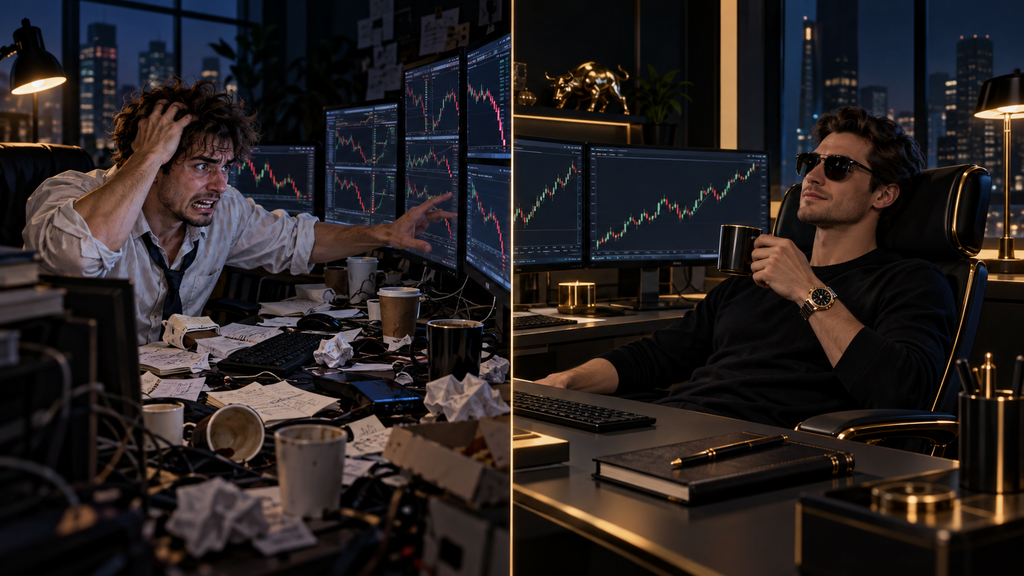
Trading psychology is the way your emotions, habits and decision-making affect how you trade.
A trading strategy may have clear rules, but those rules are only useful if the trader can follow them consistently.
Emotions such as fear, greed, frustration and excitement can influence decisions before, during and after a trade.
This can lead traders to:
- enter trades they did not plan
- risk more than intended
- close winning trades too early
- hold losing trades too long
- chase price after missing an entry
- trade again immediately after a loss
- ignore their own rules
Good trading psychology does not mean removing emotion completely.
It means recognising when emotion is influencing a decision and continuing to follow a structured trading process.
Key Takeaway
Trading psychology is about controlling your decisions when money, uncertainty and emotion are involved.
Fear of Losing
- Losses are unavoidable in trading
- Fear can prevent valid trades from being taken
- Fear can also cause trades to be closed too early
- Risk should be small enough that a loss remains manageable
After experiencing losses, a trader may become hesitant to enter another trade even when it meets their plan.
They may also enter correctly but close the position as soon as price moves slightly against them.
This can result in good trading ideas being abandoned before they have had time to develop.
Reducing risk to a comfortable level can help because each individual trade becomes less emotionally important.
Key Takeaway
A planned loss should be an acceptable business outcome, not an emergency.
Fear of Missing Out
- Often called FOMO
- Happens when traders feel they must enter before an opportunity disappears
- Can lead to chasing price
- Often causes entries outside the original plan
Imagine price moves sharply higher without giving you the entry you wanted.
You may feel that if you do not enter immediately, you will miss the entire move.
This can lead to buying after price has already moved significantly away from the planned entry.
The risk may now be larger, the Stop Loss may be less suitable and the original opportunity may no longer exist.
There will always be another trade.
Missing an opportunity is not the same as losing money.
Key Takeaway
A missed trade costs nothing. Chasing a missed trade can.
Greed
- Can cause traders to risk too much
- Can prevent planned profits from being taken
- Often appears after a winning streak
- Can make normal returns feel insufficient
A trader may begin with a clear Take Profit but decide to move it further away because the trade is currently winning.
Sometimes this produces additional profit.
Other times price reverses and a planned winning trade becomes much smaller or even turns into a loss.
Greed can also encourage larger position sizes after several successful trades.
Confidence is useful, but a short winning streak does not remove risk from the next trade.
Key Takeaway
Do not allow a profitable trade or winning streak to change your risk rules without a planned reason.
Revenge Trading
- Often follows a frustrating loss
- The goal becomes recovering money rather than following a setup
- Position size may increase
- Trade quality often decreases
Revenge trading happens when a trader feels the need to win back a loss immediately.
For example:
You lose £50 on a planned trade.
Instead of waiting for another valid setup, you quickly enter another position because you want the £50 back.
If that trade also loses, frustration can increase further.
This can create a cycle:
loss → frustration → impulsive trade → larger loss → more frustration
On a personal live account, this can quickly damage your own capital.
On a prop firm account, several emotional trades can also rapidly move the account towards daily or maximum-loss limits.
Key Takeaway
The market does not know how much you lost, and it does not owe you the money back.
Overtrading
- Taking more trades does not guarantee more profit
- Boredom can lead to unnecessary entries
- Lower-quality setups often appear attractive after long periods watching charts
- More trades also mean more exposure to spread, commission and risk
Some traders feel they need to be in the market constantly.
However, there may be long periods when no suitable opportunity exists.
A trader who takes ten poor setups is not necessarily working harder than a trader who waits patiently for two good ones.
Overtrading can be especially damaging after losses because traders may take repeated positions trying to recover quickly.
Key Takeaway
Being active is not the same as being productive. Sometimes the correct trading decision is to do nothing.
Winning Streaks and Overconfidence
- Winning trades can create excessive confidence
- Risk may gradually increase
- Trading rules may begin to feel unnecessary
- Every new trade still has an uncertain outcome
A series of profitable trades can make a trader feel as though they understand exactly what the market will do next.
This is dangerous.
A winning streak may simply be a normal part of the statistical performance of a strategy.
The next trade can still lose.
On a prop firm account, increasing risk after a winning streak can also expose profits and remaining drawdown unnecessarily.
Key Takeaway
Confidence should come from following a tested process, not from believing the next trade cannot lose.
Losing Streaks and Confidence
- Several losses can occur even with a profitable strategy
- Confidence may fall
- Traders may begin changing rules too quickly
- Risk should remain controlled
A trader who experiences several losses in a row may start questioning everything.
They may:
- change strategy
- move Stop Losses
- avoid valid setups
- reduce targets
- increase risk to recover
- add new indicators without testing them
One losing streak does not automatically prove that a trading plan has stopped working.
Performance should be reviewed across a meaningful number of trades rather than judged from a small group of results.
Key Takeaway
Do not rebuild your entire trading plan because of a normal sequence of losses.
Following Your Trading Plan
- Know what qualifies as a trade
- Know what invalidates the setup
- Define risk before entry
- Decide when you will and will not trade
- Avoid making rules while already in a position
A trading plan removes some of the decisions that emotions might otherwise influence.
Before the trading session begins, you can already know:
- which markets you will trade
- which sessions you will trade
- what setup you are looking for
- how much you will risk
- where the Stop Loss should be
- what would make you avoid the trade
This does not guarantee profit.
It simply means decisions are made from a plan rather than from the emotion of the moment.
Key Takeaway
Make as many decisions as possible before money is at risk.
Patience
- Good setups may not appear every day
- Price does not need to be chased
- Waiting is part of trading
- Quality is usually more important than quantity
Patience means being willing to wait for your conditions.
This can be difficult when watching price move without you.
However, entering simply because the market is moving is different from entering because your setup is present.
A trader who waits for suitable opportunities can often avoid many unnecessary losses created by boredom or FOMO.
Key Takeaway
You do not need to trade every market movement.
Discipline
- Discipline means following your rules repeatedly
- It matters most when emotion is strongest
- One rule break can create much larger risk than intended
- Consistency makes performance measurable
Discipline is not about being perfect.
It is about reducing unnecessary decisions and repeatedly following a process.
For example, if your rule says:
maximum 1% risk per trade
then using 3% because you strongly believe one setup will win is not disciplined risk management.
The same applies to prop firm accounts, where a single oversized trade can consume a significant part of the permitted drawdown.
Key Takeaway
Discipline means following the plan even when you feel tempted to make an exception.
Knowing When to Stop Trading
- Set limits before the session begins
- Avoid continuing after emotional losses
- Fatigue affects decision-making
- A poor trading day does not need to become a disastrous one
There may be times when the best decision is to stop for the day.
Possible reasons include:
- reaching your planned daily loss limit
- several consecutive losses
- breaking your own trading rules
- feeling angry or frustrated
- being tired or distracted
- repeatedly entering poor-quality setups
Prop firm traders should also remain aware of any daily-loss restrictions.
Stopping before a formal limit is reached can leave more room for future trading.
Key Takeaway
Protecting tomorrow’s trading opportunity can be more important than trying to recover today’s loss.
Focus on Process, Not Individual Results
- A winning trade can still be a bad trade
- A losing trade can still be well executed
- Judge whether the rules were followed
- Review results over multiple trades
Imagine you ignore your trading plan, enter randomly and make £200.
The trade made money, but the decision was poor.
Now imagine you follow every rule, risk correctly and the trade loses £20.
Financially, the second trade lost money.
From a process perspective, it may have been the better trade.
If traders judge themselves only by profit and loss, bad habits can be rewarded temporarily.
Key Takeaway
Judge the quality of the decision separately from the outcome of the trade.
Using a Trading Journal
- Record losing trades
- Record rule breaks
- Identify repeated mistakes
- Review emotional decisions
- Look for patterns over time
Memory is unreliable, particularly when emotions are involved.
A trading journal creates a record of what actually happened.
After several weeks or months, patterns may become visible.
For example:
- most losses happen during one session
- trades taken after a previous loss perform poorly
- Stop Losses are repeatedly moved
- FOMO trades consistently underperform
- rules are broken more often after a winning streak
These patterns are difficult to identify without records.
Relevant Trader Tool
Use the Trading Journal to review losing trades, identify repeated mistakes and record whether your rules were followed.
Key Takeaway
A journal turns trading psychology from a feeling into something you can actually review and measure.
Personal Live Accounts and Prop Firm Accounts
- Emotional behaviour affects both
- The consequences may differ
- Prop rules can add additional pressure
- Account size should not change disciplined behaviour
Trading a personal live account means your own money is directly at risk.
A prop firm account can feel different because the headline account balance may be much larger than the trader’s personal capital.
This can sometimes encourage traders to take larger risks than they normally would.
Prop firm evaluations can also create additional pressure because traders may focus on:
- profit targets
- daily-loss rules
- maximum drawdown
- passing the evaluation quickly
These pressures should not replace normal risk management.
Key Takeaway
Whether the account is personal or provided by a prop firm, the quality of your decision-making should remain the same.
Common Trading Psychology Mistakes
- Chasing trades because of FOMO
- Increasing risk after losses
- Increasing risk after wins
- Moving Stop Losses emotionally
- Closing trades early because of fear
- Taking trades because of boredom
- repeatedly changing strategy
- trying to recover losses immediately
- ignoring fatigue or frustration
- judging every decision solely by profit or loss
Psychological mistakes often begin when the trader stops following a repeatable process.
The objective is not to become emotionless.
The objective is to recognise emotions without allowing them to control every trading decision.
Key Takeaway
Emotions are normal. Uncontrolled decisions are the problem.
Trading Psychology — Key Takeaways
You should now understand that:
- emotions can influence trading decisions
- fear can prevent valid trades or cause early exits
- FOMO can lead to chasing price
- greed can increase risk
- revenge trading can quickly increase losses
- overtrading creates unnecessary exposure
- winning streaks can create overconfidence
- losing streaks can damage confidence
- patience and discipline are essential
- knowing when to stop trading protects capital
- good decisions should be judged separately from individual outcomes
- journaling can expose repeated psychological mistakes
- the same principles apply to personal live and prop firm accounts
Remember
You cannot control every market outcome, but you can work to control the decisions you make before, during and after each trade.
Continue Learning
Next: Journaling & Trade Review
The next lesson focuses on how to record your trades, identify repeated mistakes and turn past results into useful information for future decisions.