What Risk / Reward Is
Risk / Reward compares how much you are prepared to lose on a trade with how much you could potentially gain.
Before entering a trade, you should ideally know three prices:
- Entry — where you plan to enter
- Stop Loss — where you accept the trade is wrong
- Take Profit — where you plan to take profit
These three levels allow you to calculate the trade’s potential reward compared with its risk.
For example:
Entry: 1.1500
Stop Loss: 1.1470
Take Profit: 1.1560
The Stop Loss is 30 pips away.
The Take Profit is 60 pips away.
You are therefore risking 30 pips to potentially make 60 pips.
That gives a 2:1 reward-to-risk ratio.
Risk / Reward Does Not Predict the Trade
A 2:1 trade does not mean the trade is twice as likely to win.
It simply means the potential profit is twice the size of the planned loss.
A trade can have an excellent reward-to-risk ratio and still lose.
Likewise, a trade with a smaller reward target may still be profitable over time if it wins often enough.
Risk / Reward is therefore one part of a trading decision — not a guarantee of success.
Why Traders Use It
Risk / Reward helps you compare trades before committing money.
It allows you to ask:
- Is the potential reward worth the amount I am risking?
- Is my Take Profit realistic?
- Is my Stop Loss too large for the opportunity?
- Does this trade fit my trading plan?
The same principle applies whether you are trading a personal live account or a prop firm account.
Relevant Trader Tool
Our Risk / Reward Calculator can calculate the ratio from your Entry, Stop Loss and Take Profit.
Key Takeaway
Risk / Reward tells you how much you are prepared to lose compared with how much you are attempting to gain. It helps you judge a trade before you enter it — but it does not tell you whether that trade will win.
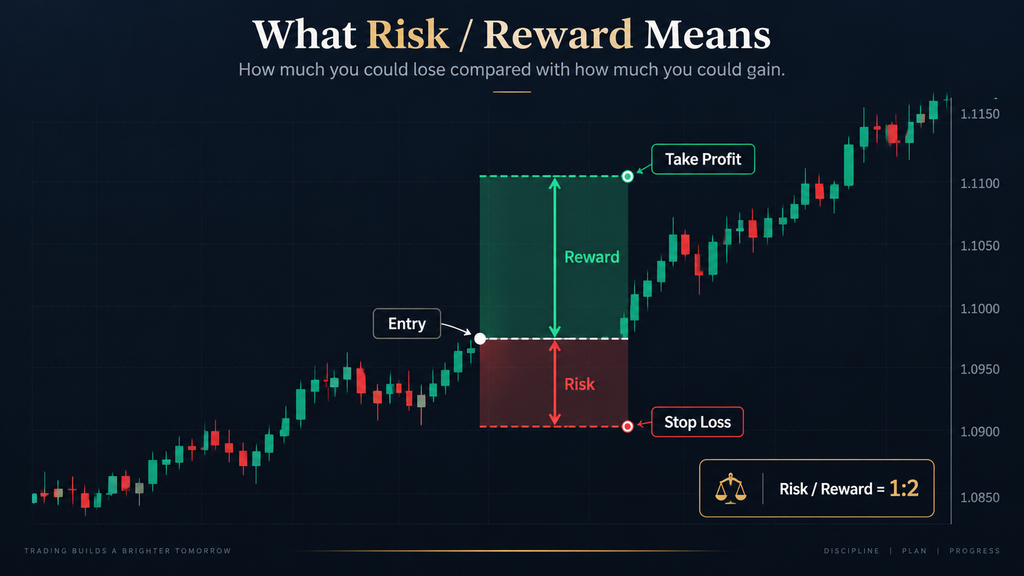
Calculating Risk / Reward
Reward-to-risk multiple = distance from Entry to Take Profit ÷ distance from Entry to Stop Loss
- Measure the distance from Entry to Stop Loss
- Measure the distance from Entry to Take Profit
- Compare the two distances
- Calculate the ratio before entering
If your Stop Loss is 20 pips away and your Take Profit is 40 pips away, your potential reward is twice your risk.
That gives:
Risk: 20 pips
Reward: 40 pips
Risk / Reward = 1:2
If the Stop Loss is 20 pips and the target is 60 pips:
Risk / Reward = 1:3
The same calculation can be made using money rather than pips.
For example:
£25 potential loss
£50 potential profit
also represents 1:2.
Relevant Trader Tool
Use our Risk / Reward Calculator to calculate the ratio using your Entry, Stop Loss and Take Profit.
Key Takeaway
Compare the distance to your Stop Loss with the distance to your target before entering the trade.
Understanding Common Ratios
- 1:1 — potential reward equals the risk
- 1:2 — potential reward is twice the risk
- 1:3 — potential reward is three times the risk
- A larger ratio is not automatically better
If you risk £20:
1:1 aims for £20 profit.
1:2 aims for £40 profit.
1:3 aims for £60 profit.
It may appear that the highest ratio is always the best choice, but this is not necessarily true.
A target that is too far away may be less realistic for the market conditions or the setup being traded.
The objective is to find a sensible relationship between risk, target distance and the probability of price reaching that target.
Key Takeaway
A larger potential reward is useful only when the target is realistic.
Risk / Reward and Win Rate
- Risk / Reward and win rate work together
- You do not need to win every trade
- Higher reward can compensate for some losing trades
- Past results do not guarantee future performance
Imagine ten trades where you risk £20 per trade.
If your winning trades make £40, you are using a 1:2 risk/reward structure.
Five winning trades could produce:
5 × £40 = £200
Five losing trades could lose:
5 × £20 = £100
Before costs, the overall result would be:
+£100
This simple example shows why a trader does not necessarily need an extremely high win rate to be profitable.
However, this depends on actually achieving the planned reward and controlling the planned losses consistently.
Key Takeaway
Risk / Reward should be considered together with how often your trading approach wins.
Break-Even Win Rate
- Different ratios require different approximate win rates
- Better reward can reduce the win rate needed to break even
- Trading costs also affect the real result
Ignoring costs for simplicity:
1:1 requires approximately 50% winning trades to break even.
1:2 requires approximately 33.3%.
1:3 requires approximately 25%.
This does not mean a trader should simply choose 1:3 targets.
If the target is unrealistic and rarely reached, the higher theoretical ratio provides little benefit.
Spread, commissions and slippage can also mean the real break-even point is slightly higher.
Key Takeaway
The relationship between win rate and reward matters more than either number on its own.
Choosing a Realistic Take Profit
- Do not choose a target purely because you want a certain ratio
- Consider what price is realistically capable of reaching
- Market structure and nearby price areas can affect the target
- Different market conditions may justify different expectations
A trader should not force every trade to have exactly the same reward target.
For example, placing a Take Profit simply because it produces 1:3 may make little sense if an important price level sits much closer.
Likewise, closing every trade at 1:1 may unnecessarily limit good opportunities when the market has room to move further.
The target should make sense for the trade itself.
Key Takeaway
Calculate Risk / Reward after identifying a sensible Stop Loss and target — not by forcing the market to fit a ratio.
Risk / Reward and Stop Loss Placement
- Do not move the Stop Loss simply to create a better-looking ratio
- Stop placement should have a trading reason
- Position size can be adjusted instead
- A smaller Stop Loss is not automatically safer
Imagine a trade has a sensible target but the correct Stop Loss produces only a 1:1.5 ratio.
Moving the Stop Loss much closer just to turn the trade into 1:2 may place it inside normal price movement.
The trade may then be stopped out even though the original idea was still valid.
It is usually better to decide where the trade becomes invalid and then judge whether the resulting Risk / Reward is worth taking.
Key Takeaway
The ratio should describe the trade plan — it should not distort the trade plan.
Risk / Reward and Position Size
- Risk / Reward describes the relationship between loss and potential gain
- Position size determines the money involved
- The same ratio can be used with very different account sizes
- Risk amount should still be controlled
Two traders could both take a 1:2 trade.
Trader A may risk:
£10 to potentially make £20
Trader B may risk:
£100 to potentially make £200
The ratio is identical, but the amount of money exposed is very different.
This is why Risk / Reward should always be considered alongside position size and account risk.
Relevant Trader Tool
Our Position Size / Lot Size Calculator can help calculate a suitable position from the amount you are prepared to risk.
Key Takeaway
Risk / Reward tells you the relationship between loss and reward. Position size determines how much money that relationship represents.
Risk / Reward on Personal and Prop Firm Accounts
- The calculation itself is the same
- The amount of risk available may differ
- Prop firm limits can restrict how much loss an account can absorb
- A good ratio does not override account rules
A 1:2 trade means the same thing whether it is placed on a personal live account or a prop firm account.
However, the amount being risked may need to be handled differently.
On your own live account, you decide how much drawdown you are prepared to accept.
On a prop firm account, daily-loss or maximum-loss limits may reduce the amount of risk available.
A trade with an attractive Risk / Reward ratio can still be unsuitable if the potential loss moves the account too close to one of those limits.
Key Takeaway
A good ratio never makes excessive account risk acceptable.
When a Good Risk / Reward Trade Still Loses
- A good ratio does not predict direction
- Stop Losses will still be reached
- Trading outcomes should be judged over multiple trades
- Avoid judging a strategy from one result
You can plan a trade perfectly with:
- a sensible Entry
- a logical Stop Loss
- a realistic Take Profit
- a strong Risk / Reward ratio
and the trade can still lose.
This is normal.
Risk / Reward is a planning tool, not a prediction tool.
Its value becomes clearer when it is applied consistently across many trades.
Key Takeaway
Judge Risk / Reward as part of a repeatable process, not by the outcome of one trade.
Common Risk / Reward Mistakes
- Choosing an unrealistic Take Profit simply to display a high ratio
- Moving the Stop Loss too close
- Ignoring spread or trading costs
- Increasing position size because the potential reward looks attractive
- Changing targets emotionally after entering
- Assuming a high ratio means a high-quality trade
A Risk / Reward figure can look excellent on paper while the actual trade makes little sense.
The purpose of calculating the ratio is to help assess the opportunity objectively.
It should never be used to make a poor setup appear more attractive.
Key Takeaway
A mathematically attractive ratio cannot rescue a badly planned trade.
Risk / Reward — Key Takeaways
You should now understand that:
- Risk is what you are prepared to lose
- Reward is what you are attempting to gain
- Entry, Stop Loss and Take Profit determine the ratio
- 1:2 means the potential reward is twice the planned risk
- Risk / Reward and win rate must be considered together
- Higher ratios are not automatically better
- Targets should be realistic
- Stop Losses should not be manipulated simply to improve the ratio
- Position size determines how much money is actually at risk
- The same principles apply to personal live and prop firm accounts
Remember
A strong trading plan defines both the potential loss and the potential reward before the trade is entered.
Next: Market Structure
Now that you understand how to define risk and reward, the next step is learning how price itself is structured.