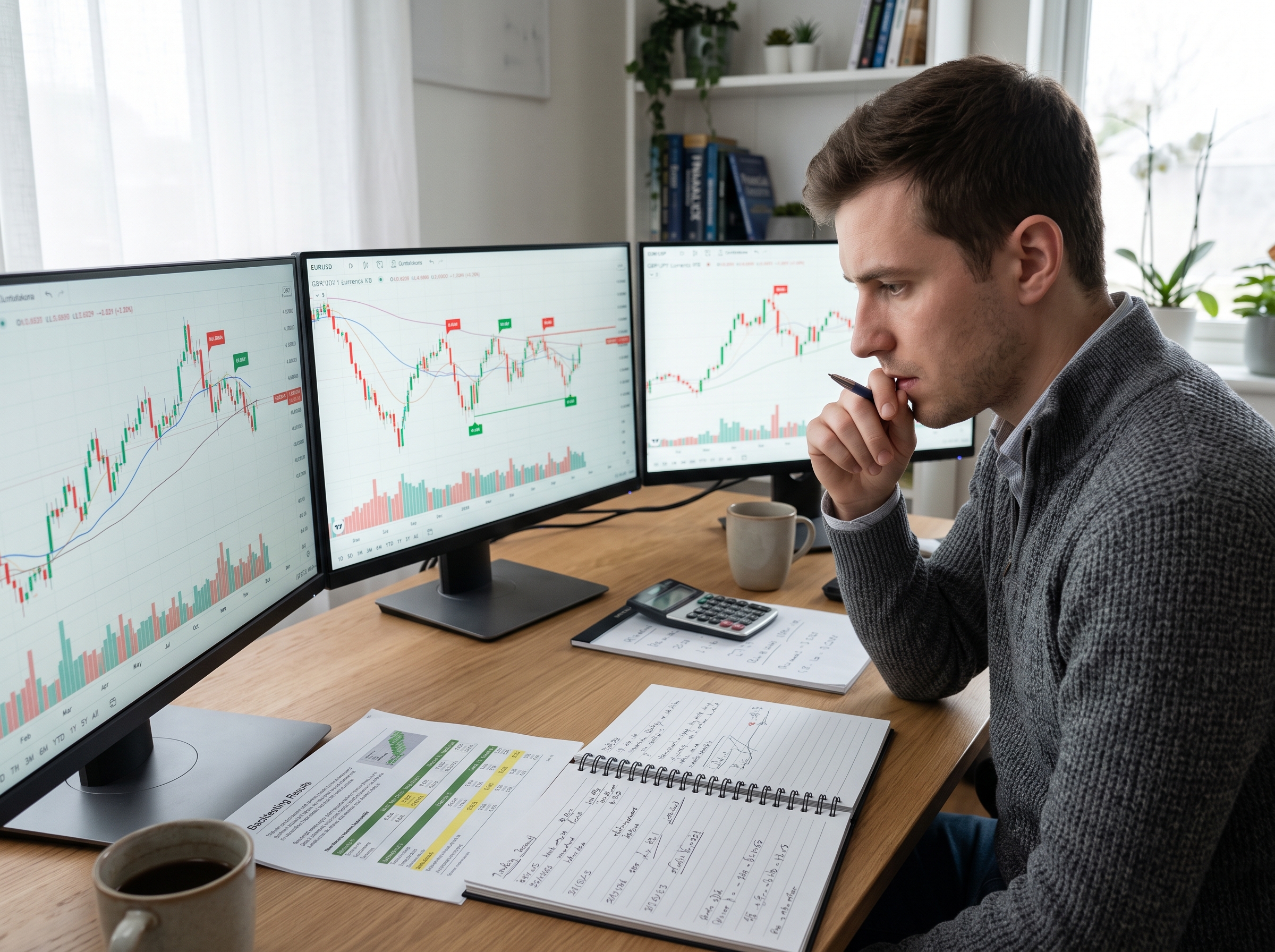
Get ready for a lot of learning, patience, backtesting and, at times, an emotional rollercoaster.
Trading can look incredibly appealing from the outside. Social media is full of traders and mentors showing winning trades, large payouts and payout certificates proudly displayed on the wall.
What you see far less often is everything that came before those moments.
The hours spent learning. The strategies that did not work. The months of charts that had to be tested. The losing streaks. The self-doubt. And the psychological pressure that appears the moment real money is involved.
If you want to become a trader, it is worth understanding that side of trading before you start risking money.
Finding a Trading Strategy Is Only the Beginning
One of the first challenges is finding a trading strategy that actually suits you.
A strategy might look great when someone else uses it, but that does not automatically mean it fits your lifestyle, available trading hours or personality.
Once you find an approach you understand, you then need to test it.
That means going back through historical price data and recording how the strategy would have performed over many different market conditions. This is where backtesting becomes important.
You may need to go through months of charts before you begin to understand whether the strategy has any consistency at all.
And even then, there is no such thing as a strategy that wins every trade.
A trading strategy can still produce losing trades regularly. A system with a win rate around 50–60% may still be workable if its losses are controlled and its winning trades are large enough to compensate for them.
This is where risk-to-reward becomes just as important as the strategy itself.
The Psychological Side of Trading Changes Everything
Backtesting a strategy and trading it live are two completely different experiences.
When you are testing historical charts, there is no money at risk. When you place a live trade, everything changes.
A trade might immediately move into drawdown. Suddenly you are watching a real financial loss appear on the screen.
Price may begin creeping towards your stop loss. You know your trading plan says to leave the trade alone, but emotionally you may want to close it.
Then something frustrating happens.
You panic, close the trade early, and a few minutes later the market turns around and moves towards where your take-profit target would have been.
The opposite can happen as well.
Imagine you have just had five losing trades in a row. Your next trade finally moves into profit.
Instead of following your original plan, the temptation to take a small profit immediately can become enormous.
You are no longer thinking about the strategy. You are thinking about avoiding another loss.
That decision can completely change the mathematics behind your trading.
If your strategy depends on winning trades being larger than losing trades, continually cutting your winners short can reduce your risk-to-reward ratio and potentially turn a workable strategy into an unprofitable one.
Discipline Matters More Than Excitement
This is one of the realities beginners often underestimate.
Trading is not simply about predicting whether a chart will move up or down.
It is about being able to follow the same process when you are winning, losing, confident, frustrated or nervous.
You need the patience to wait for your setup.
You need the discipline to avoid taking trades simply because you are bored.
You need the confidence to follow a strategy you have properly tested.
And you need enough risk control that one losing trade — or even a run of losing trades — does not destroy your account or your confidence.
A prop firm can change how much of your own money you are risking, but it does not remove the psychological pressures involved in trading. You still have rules, drawdown limits and performance decisions to manage.
Do You Still Want to Become a Trader?
None of this means trading cannot be rewarding. It can be.
But becoming a trader involves far more than opening a chart and finding a buy or sell signal.
It requires time spent learning, testing, recording results, understanding risk and learning how you personally react when money is on the line.
You will probably make mistakes.
You will almost certainly experience losing trades.
You may question your strategy and yourself more than once.
The goal is not to avoid every loss. It is to build a process that allows you to manage losses without abandoning your plan every time trading becomes uncomfortable.
These are only a few of the things a beginner trader can experience.